Free embroidery pattern ·
Beginner Embroidery Patterns Free: Wildflower Sampler
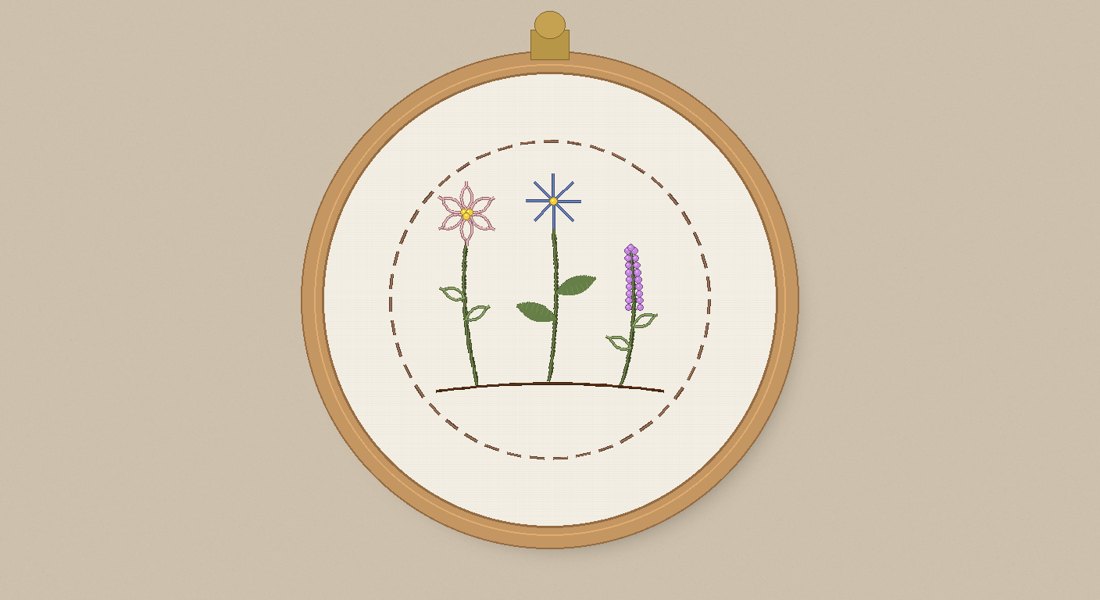
| Finished size | 4.5 in design in a 6 in (15 cm) hoop |
|---|---|
| Stitches | 7: running, back, stem, satin, lazy daisy, straight, French knot |
| Threads | 9 DMC colours, 2 strands |
| Fabric | Cotton or linen-cotton, 10 x 10 in |
| Level | Beginner |
| Time | about 4-6 hours |
| Price | Free |
Jump to the pattern Printable PDF (free) Save it on Pinterest
What you need
- 10 x 10 in light cotton or linen-cotton fabric
- DMC floss: 3863, 433, 3347, 988, 989, 3716, 3839, 209, 726 (one skein each)
- 6 in embroidery hoop and a size 7 embroidery needle
- Water-soluble fabric pen, scissors
How it's made, in short
- Transfer the design. Print the template at 100%, check the 1 in square, and trace it onto the fabric with a water-soluble pen.
- Hoop the fabric. Put the fabric in a 6 in hoop, drum tight.
- Step 1. Stitch the dotted ring around the design in running stitch.
- Step 2. Backstitch the ground line along the bottom.
- Step 3. Stem stitch the three stems, each from the ground line up to its flower.
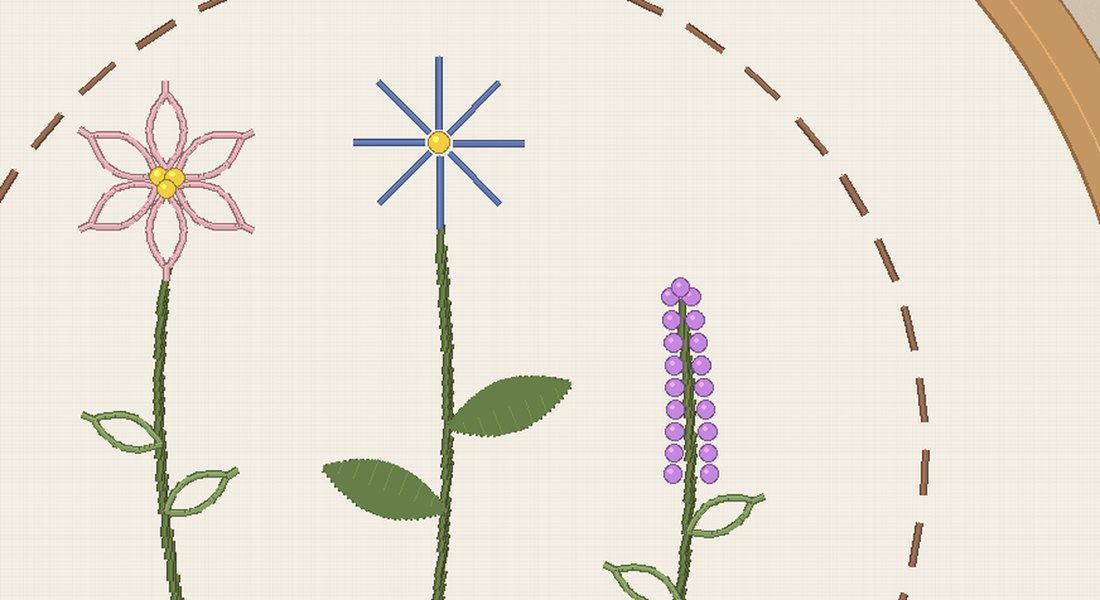
- Step 4. Fill the two leaves on the middle stem with satin stitch.
- Step 5. Work the four small leaves on the left and right stems in detached chain (lazy daisy).
- Step 6. Work the six daisy petals on the left stem in detached chain.
- Step 7. Work the eight petals of the star flower on the middle stem as single straight stitches.
- Step 8. Cover the top of the right stem with French knots in pairs for the lavender, plus one at the tip.
- Step 9. Add three French knots in the middle of the daisy and one in the middle of the star flower.
- Finish. Rinse out the pen lines, press, re-hoop and gather the back with a running stitch.
Tips
- Separate two strands from an 18 in length one at a time, then put them back together; they lie flatter.
- Keep the fabric drum tight in the hoop, especially for French knots and satin stitch.
- Do not carry thread across the back between flowers; it shows through light fabric. Finish and start again.
The free pattern
Stitch names follow the common English names; lazy daisy is the same stitch as detached chain.
Size: design 4.5 x 4.5 in (11.5 x 11.5 cm), for a 6 in (15 cm) hoop
Fabric: a 10 x 10 in (25 x 25 cm) square of light cotton or linen-cotton, washed and pressed
Threads: DMC 6-strand embroidery floss, one skein of each colour; use 2 strands throughout. Lengths are the 2-strand thread you stitch with, with spare, cut in 18 in (45 cm) pieces:
- DMC 3863 Medium Mocha Beige Brown: about 24 in (61 cm)
- DMC 433 Medium Brown: about 16 in (41 cm)
- DMC 3347 Medium Yellow Green: about 33 in (84 cm)
- DMC 988 Medium Forest Green: about 24 in (61 cm)
- DMC 989 Forest Green: about 10 in (25 cm)
- DMC 3716 Very Light Dusty Rose: about 14 in (36 cm)
- DMC 3839 Medium Lavender Blue: about 10 in (25 cm)
- DMC 209 Dark Lavender: about 40 in (102 cm)
- DMC 726 Light Topaz: about 15 in (38 cm)
Notions: 6 in embroidery hoop, size 7 embroidery needle, water-soluble fabric pen or a light pencil, scissors
Stitches: running stitch, backstitch, stem stitch, satin stitch, detached chain (lazy daisy), straight stitch, French knot
Transfer
Print the template page at 100% (actual size) and measure the 1 in scale square; if it is not exactly 1 in, check the print setting. Tape the template to a window, centre the fabric over it and trace every line and dot with the pen.
Put the fabric in the hoop so it is drum tight, with the screw at the top.
Stitch guide
Running stitch: Bring the needle up on the line, go down 1/8 in further along, come up again 1/16 in on, and repeat, so you get even dashes with gaps between them.
Backstitch: Bring the needle up one stitch length along the line, go down at the start of the line, then come up one stitch length ahead of your last stitch and go back down into the end of it, so the stitches touch.
Stem stitch: Work left to right along the line. Come up at the start, go down 1/8 in along, and come up halfway back along that stitch, keeping the thread below the needle; repeat so each stitch overlaps half of the one before like a twisted rope.
Satin stitch: Fill the leaf with straight stitches laid side by side across its width, from one edge of the outline to the other, close enough that no fabric shows; start in the middle of the leaf and work out to each tip so the angle stays even.
Detached chain: Also called lazy daisy. Come up at the base of the petal, go back down in the same hole leaving a loop, come up at the tip of the petal inside the loop, and go down just outside the loop to tack it in place.
Straight stitch: One single stitch: come up at the inner end of the line and go down at the outer end, keeping the thread smooth and not too tight so it lies flat.
French knot: Come up where the knot goes, wrap the thread twice around the needle, hold the wraps snug with your other hand, and go down right next to where you came up, pulling the thread through slowly.
Order of work
- Stitch the dotted ring around the design in running stitch. DMC 3863, 2 strands.
- Backstitch the ground line along the bottom. DMC 433, 2 strands.
- Stem stitch the three stems, each from the ground line up to its flower. DMC 3347, 2 strands.
- Fill the two leaves on the middle stem with satin stitch. DMC 988, 2 strands.
- Work the four small leaves on the left and right stems in detached chain (lazy daisy). DMC 989, 2 strands.
- Work the six daisy petals on the left stem in detached chain. DMC 3716, 2 strands.
- Work the eight petals of the star flower on the middle stem as single straight stitches. DMC 3839, 2 strands.
- Cover the top of the right stem with French knots in pairs for the lavender, plus one at the tip. DMC 209, 2 strands.
- Add three French knots in the middle of the daisy and one in the middle of the star flower. DMC 726, 2 strands.
Finishing
- Rinse the fabric in cool water to remove the pen lines, roll it in a towel and press it face down on a soft towel.
- Put it back in the hoop centred, tighten the screw, and trim the fabric to 1 in outside the hoop.
- Run a running stitch around that edge, pull it up at the back like a drawstring, and tie off.
Counts: 43 running stitch dashes, 23 French knots, 10 detached chains, 8 straight stitches, 2 satin-stitch leaves, 3 stem-stitched stems, 1 backstitched ground line.
How we checked it: xstitchlib/embroidery.py: 7 stitch names in the dictionary, each explained; 9 DMC threads listed and used; hoop 6 in for a 4.5 in design; scale square; lengths fit one skein each. We work hard to get every number right, but mistakes can still happen; tell us at hello@craftuary.com if anything is off.
Want it on paper?
The printable PDF (US Letter and A4), with the true-size template to trace, is free with a Craftuary account.
Get the printable PDF freeQuestions
What is the easiest embroidery pattern for beginners?
A small sampler like this one: each flower teaches one or two basic stitches, and all seven are explained step by step on the pattern.
What stitches does a beginner embroidery sampler use?
Running stitch, backstitch, stem stitch, satin stitch, detached chain (lazy daisy), straight stitch and French knots.
How many strands of embroidery floss should I use?
Two strands of DMC 6-strand floss for every stitch in this pattern; separate them from an 18 inch length.
What size hoop do I need?
A 6 inch (15 cm) hoop for the 4.5 inch design, so there is fabric to grip all round.
The pictures are drawn from the pattern's own measurements and stitches; your finished piece will vary a little with your materials.
Embroidery and cross stitch patterns: every embroidery pattern on Craftuary.
Embroidery guides: free how-to guides.
Other crafts: Crochet patterns · Sewing patterns · Knitting patterns