Best Fabrics for a Quilted Pencil Bow — What Actually Works (and What to Avoid)

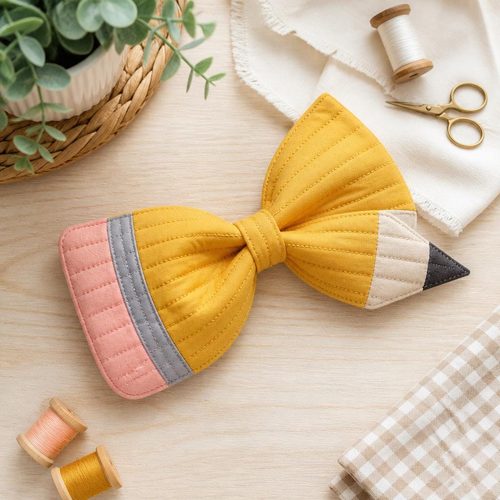
Pencil Bow Sewing Pattern, $4.99. Instant download, A4 and US Letter.
See the pattern
What fabric should I use to make a quilted pencil bow for a teacher gift?
Why Fabric Choice Makes or Breaks a Quilted Pencil Bow
A quilted pencil bow is not a floppy ribbon accent — it is a structured, three-dimensional decoration that needs to hold its shape on a gift bag, a wreath, or a lanyard for months. The fabric you choose directly determines whether your finished bow looks crisp and gift-ready or limp and disappointing. Stiff fabrics trap the quilted texture beautifully and let the bow stand upright, while fabrics that are too drapey collapse at the knot and lose the signature pencil silhouette. This means the fabric decision is arguably more important than any single step in the sewing process itself. Getting this right before you cut a single piece of fabric saves you time, materials, and frustration.
Cotton Quilting Fabric: The Clear Winner for Most Makers
100% cotton quilting fabric — the kind sold on bolts at craft stores in fat-quarter cuts — is the single best choice for a large quilted pencil bow. It has just enough body to hold the pointed pencil-tip shape without being so stiff that it is difficult to fold and tie. Cotton presses beautifully, which means your seams stay flat and your quilted layers lie smooth after ironing. It also plays well with a lightweight fusible batting or fleece, giving you the puffed, padded texture that makes a quilted bow feel substantial and handmade-premium rather than craft-fair cheap. Prints with small geometric or novelty patterns — apples, rulers, ABCs, polka dots — read clearly at bow scale and photograph well for gift photos.
What About Felt, Canvas, or Home Décor Fabric?
Felt is tempting because it requires no hemming and comes in bright colors, but it compresses flat under the quilting stitches and loses the raised, dimensional look that defines this style of bow. It also pills and stretches at the knot center over time, so teacher gifts made with felt bows tend to look tired by the end of the school year. Canvas and upholstery-weight home décor fabrics are too thick to fold smoothly at the pencil tip, and they make hand-sewing or machine-sewing the pointed end a struggle. Minky and cuddle fabrics shift unpredictably when layered with batting, resulting in uneven quilting lines. Stick with woven quilting cotton or a cotton-linen blend (no more than 30% linen) for results that consistently look clean and professional.
Batting and Interfacing: The Hidden Layers That Define the Look
The quilted effect in a pencil bow comes from sandwiching a thin batting layer between the front fabric and a backing fabric, then stitching lines or shapes across the surface. For a large bow, low-loft polyester batting or fusible fleece gives you a nicely puffed surface without adding so much bulk that the bow becomes difficult to tie or knot. Avoid high-loft batting — the kind used for bed quilts — because it makes the bow puffy in an uneven, lumpy way rather than a smooth, intentional way. If you want extra structure at the knot without added thickness throughout, a small rectangle of firm woven interfacing (like Pellon 809 Décor Bond) placed only at the center knot piece keeps the bow upright on a gift bag handle without stiffening the loops. This layering strategy is what separates a bow that looks handmade in the best sense from one that simply looks homemade.
How Much Fabric Do You Need for a Large Pencil Bow
A large quilted pencil bow — one sized to sit proportionally on a standard gift bag or a 10-inch wreath — typically requires between one-quarter yard and one-half yard of quilting cotton for the main bow body, depending on the specific pattern dimensions. You will also need a matching or coordinating quarter yard for the backing fabric and a piece of batting cut to the same dimensions. The pencil-tip accent (the yellow eraser end and silver ferrule detail) is often cut from small fabric scraps, so those pieces do not require separate yardage purchases. If you are making several bows as a batch of end-of-year teacher gifts, one yard of a hero print paired with a half yard of a coordinating solid can comfortably yield two to three large bows, making this a genuinely economical handmade gift. The PDF sewing pattern from Craftuary includes a cutting guide with exact dimensions, so there is no guesswork about waste or seam allowance.
Coordinating Fabric Colors for Different Teacher Gift Occasions
End-of-year teacher appreciation gifts call for bright, cheerful school-supply prints — think classic yellow No. 2 pencil fabrics, red apple motifs, or rainbow-striped patterns that read as celebratory. Back-to-school gifts benefit from fresh, clean color palettes like navy and white, sage and cream, or bold primary colors that feel energetic rather than sentimental. Holiday teacher gifts in December can use classic Christmas prints or elegant winter patterns like snowflakes on a deep green or burgundy ground, which photograph beautifully on kraft paper gift bags. If you want the bow to work across multiple occasions, a neutral buffalo check or a small geometric print in the teacher's favorite color is always appropriate. The quilted texture of the bow adds enough visual interest that even a solid-color fabric looks intentional and polished, so do not feel pressured to find a novelty print if your local shop is limited in selection.
Getting the Pattern and Starting Your Project
The Craftuary Large Pencil Bow Sewing Pattern is a downloadable PDF, which means you can purchase it once and print it as many times as you need — useful when you are making a batch of gifts for multiple teachers or when a friend wants to make one too. The pattern includes all pieces for the bow loops, the pencil-tip point, the ferrule detail, and the center knot wrap, along with guidance on assembly order. Because it prints at home on standard letter or A4 paper, there is no waiting for shipping, and you can start cutting fabric the same day. If you have basic sewing experience — straight stitch, basic pressing, turning a sewn shape right-side-out — you have all the skills this project requires. The quilted layering is straightforward diagonal or grid stitching done before assembly, not complex free-motion quilting, so it is an approachable project even if you have never made a quilted item before.
Key Takeaways
- 100% cotton quilting fabric is the best material for a large quilted pencil bow because it holds shape, presses well, and pairs cleanly with batting.
- Avoid felt, canvas, and minky fabrics — they create structural or texture problems that undermine the finished look.
- Low-loft polyester batting or fusible fleece gives the right amount of puff without making the bow too bulky to tie.
- One-quarter to one-half yard of quilting cotton is typically enough for a single large bow, making this an economical handmade gift.
- The Craftuary PDF pattern includes a cutting guide so there is no guesswork on fabric quantities or seam allowances.
- Fabric color and print selection can be tailored to the occasion — end-of-year, back-to-school, or holiday — with the same pattern.
- The quilting step uses simple straight-line stitching and does not require free-motion quilting skills.