The Easiest Chunky Crochet Blanket Pattern for Beginners: A Complete Guide

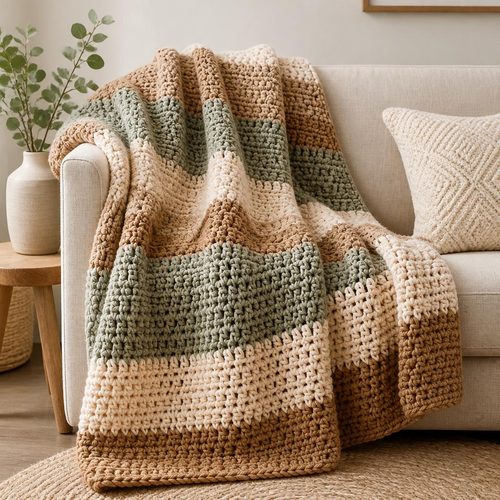
Chunky Colour Block Throw, $4.99. Instant download, A4 and US Letter.
See the pattern
What is the easiest crochet blanket pattern for beginners who want a chunky throw afghan?
The Direct Answer: Yes, a Chunky Throw Afghan Is the Best First Blanket Project
If you are new to crochet and want to make a blanket, a chunky throw afghan is genuinely the single best starting project — not because it is a consolation prize for beginners, but because its construction is optimally suited to building real skill fast. Chunky-weight yarn (typically labeled as #6 Super Bulky or #5 Bulky) works up quickly on a large hook, so you complete recognizable rows within minutes rather than hours, which keeps motivation high. The stitches used in most modern chunky throw patterns — most commonly the single crochet, half double crochet, or a basic granny square cluster — are the same foundational stitches that appear in virtually every other crochet project you will ever make. Because the yarn is thick, it is also far easier to see and count your stitches, which eliminates the most common source of beginner frustration: losing your place in a row. A well-written PDF pattern with photos and stitch counts guides you through each step so you are never guessing.
Which Stitches Appear in Easy Chunky Blanket Patterns (And What They Actually Look Like)
The vast majority of beginner-friendly chunky crochet blanket patterns rely on just two or three stitches repeated across every row. The half double crochet (hdc) is the most popular choice for modern throw designs because it creates a dense, slightly textured fabric that photographs beautifully and holds its shape well after washing. The single crochet (sc) produces a tighter, firmer fabric and is the most forgiving stitch for absolute beginners because the hook enters only one obvious loop. Some patterns introduce the moss stitch or linen stitch — an alternating sequence of single crochets and chain stitches — which looks impressively complex but takes only about ten minutes to learn. A turning chain at the end of each row is the one technique that trips up most beginners: in chunky blanket patterns, this is almost always just one or two chains, and a good pattern will remind you of this every single time so you never accidentally add extra stitches to your row count.
Yarn and Hook Size: What You Actually Need to Buy
For a standard adult throw measuring approximately 50 by 60 inches, you will need between 800 and 1,200 yards of Super Bulky (#6) yarn depending on the stitch pattern and your personal tension. Brands like Lion Brand Pound of Love (available in bulky) or Bernat Blanket yarn are widely available at craft stores and online, and both are machine-washable — a practical necessity for any blanket that will actually be used. Your hook size should match the yarn label recommendation, but for chunky throw patterns most designers call for a 9mm to 12mm crochet hook; a 10mm (US size N/P-15) is the most common all-around choice. Ergonomic hooks with cushioned handles are worth the small extra cost when you are making a blanket, because you will complete hundreds of stitches per session and hand fatigue is real. Always buy one extra skein beyond your pattern's stated yardage — dye lots vary between manufacturing batches, and running out of matching yarn mid-blanket is a problem that is very easy to avoid and very frustrating to fix.
How to Read a Crochet Blanket PDF Pattern: A Practical Walkthrough
A quality crochet PDF pattern opens with a materials list, a gauge swatch specification, and an abbreviations key — read all three before you pick up your hook, because skipping this step is the number-one cause of a finished blanket that comes out the wrong size. Gauge tells you how many stitches and rows equal four inches in the specified stitch; if your swatch is looser than the pattern gauge, go down a hook size, and if it is tighter, go up a hook size. Pattern instructions are written in shorthand (for example, 'hdc in each st across, turn' means 'work a half double crochet into every stitch along the entire row, then turn your work to begin the next row'), and the abbreviations key decodes every term used. Stitch counts in parentheses at the end of a row — like '(60 sts)' — are your checkpoints: count your stitches at the end of every row for the first ten rows until you trust your consistency. If your PDF includes photos of each completed row or step, use them; visual confirmation is faster than re-reading text instructions when you are holding yarn and a hook.
How Long Does It Take to Crochet a Chunky Throw Blanket?
A Super Bulky chunky throw afghan typically takes a beginner between 12 and 20 hours of actual crocheting time to complete, spread across several sessions. Because chunky yarn works up so quickly, many crafters complete the entire blanket in a single weekend of casual crafting — a Saturday movie marathon with yarn in hand can easily produce 15 or more rows. Your speed will increase dramatically after the first few rows once your hands have memorized the stitch rhythm, which is one of the reasons blanket projects are so effective for building muscle memory. Projects that use a single repeating stitch pattern (rather than complex colorwork or motifs) are the fastest because you are never stopping to count a complicated sequence. If you are crocheting as a gift with a deadline, a chunky throw is one of the only blanket styles that a beginner can realistically start and finish within a week of casual evening sessions.
What Makes a Crochet PDF Pattern Worth Buying (vs. a Free Pattern)
Free crochet patterns vary enormously in quality: some are excellent, but many lack row-by-row stitch counts, skip gauge information entirely, or use inconsistent abbreviations that confuse even experienced crocheters. A well-designed paid PDF pattern — typically priced between $5 and $10 for a single design — is written, tested, and edited specifically to prevent beginner mistakes before they happen, with clearly photographed steps and a consistent abbreviation system throughout. The best digital patterns are formatted so you can print them cleanly on standard paper or read them on a tablet without zooming into blurry text. Craftuary at shopcedarcompass.com offers an instant-download PDF crochet blanket pattern for this chunky throw design that includes full written instructions, stitch count checkpoints after every row, a materials list with specific product recommendations, and finish/weave-in guidance — everything in a single file you can access immediately after purchase. Instant download means there is no shipping wait and no risk of a package being lost; you buy, you download, you print or open on your device, and you cast on the same day.
Common Beginner Mistakes in Crochet Blanket Projects (And How to Avoid Them)
The most universal beginner mistake is accidentally increasing or decreasing stitch count across rows, which causes the sides of the blanket to wave or splay instead of lying flat. This almost always happens because of how the turning chain is counted: in half double crochet patterns, the turning chain typically does NOT count as a stitch, so you should not work into it at the end of the following row — a good pattern will state this explicitly. Crocheting too tightly is the second most common issue; if you find yourself muscling the hook through each stitch, loosen your grip on both the hook and the yarn and let the yarn flow more freely through your fingers. Skipping the gauge swatch is the third mistake, and it is the one most experienced crafters admit to making regularly — skipping it is understandable but produces blankets that are the wrong dimensions, so at minimum do a 10-stitch, 10-row swatch and measure it. Finally, weave in your yarn ends as you go rather than leaving them all for the end; on a large blanket, a pile of 30 loose ends at the finish line is genuinely demoralizing, and weaving in two ends after each skein change takes less than five minutes.
Key Takeaways
- A chunky throw afghan is the single best crochet blanket project for beginners because the thick yarn and large hook make stitches fast, visible, and easy to count.
- Most easy chunky blanket patterns use only the half double crochet or single crochet stitch repeated across every row.
- You need approximately 800–1,200 yards of Super Bulky (#6) yarn and a 9mm–12mm hook for a standard 50x60-inch throw.
- Always check stitch counts at the end of every row for the first ten rows to catch increases or decreases before they distort the blanket shape.
- A quality PDF pattern provides stitch count checkpoints, a gauge swatch specification, and an abbreviations key — all essential for beginner success.
- A chunky throw blanket takes most beginners 12–20 hours total and can realistically be finished in a single weekend.
- Craftuary at shopcedarcompass.com offers an instant-download PDF with full written instructions, row-by-row stitch counts, and materials recommendations for this exact design.