How to Knit a Mini Christmas Tree Skirt for a Tabletop Tree (Complete Guide)

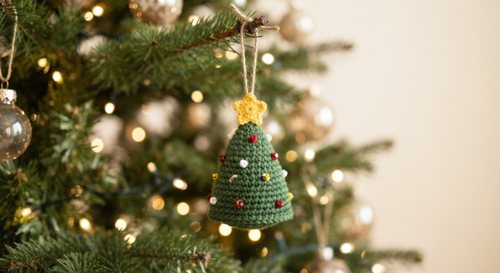
Mini Christmas Tree Ornament, free. Instant download, A4 and US Letter.
Get the free pattern
How do you knit a mini tree skirt for a small tabletop Christmas tree?
What Size Should a Mini Tree Skirt Be?
A mini tree skirt for a tabletop Christmas tree typically measures between 8 and 14 inches in diameter, depending on the base width of your tree. Most 18-to-24-inch tabletop trees have a stand footprint of roughly 5 to 7 inches across, so a finished skirt diameter of 10 to 12 inches strikes the ideal balance — it frames the tree without overwhelming a shelf or side table. To find the right size, measure the widest point of your tree stand and add 2 to 3 inches on each side for a proportional overhang. Unlike full-size tree skirts that run 48 inches or more, mini versions come together quickly and use very little yarn, making them an excellent weekend knitting project. If you plan to stack two or three small trees at different heights on a mantel, knitting skirts in graduated diameters — say 8, 10, and 12 inches — creates a cohesive, layered display.
Best Yarn and Needle Size for a Tabletop Tree Skirt
For a mini tree skirt, worsted-weight yarn (CYCA #4) on US size 7 or 8 (4.5 or 5 mm) needles is the most forgiving and commonly recommended choice, because it produces a fabric with enough body to hold its circular shape flat without curling. Bulky yarn can work for an ultra-quick knit, but it tends to make miniature projects look oversized and lumpy — the stitch definition disappears, and festive colorwork becomes muddy. DK weight (#3) is a beautiful choice if you want finer detail or plan to incorporate stranded colorwork like Nordic snowflakes or reindeer motifs, though it does add knitting time. For fiber content, 100% wool or a wool-acrylic blend is ideal: wool felts slightly with blocking for a crisp, flat result, while the acrylic content adds washability — useful if the skirt will be handled by kids or pets every holiday season. Plan on approximately 50 to 80 yards of main color yarn for a 10-inch skirt, plus small amounts of contrast colors if you're adding stripes or a colorwork border.
How the Construction Works: Knitting in the Round vs. Flat
Mini tree skirts are most commonly knitted in the round from the center outward, using a technique called circular increases — you start with a small number of cast-on stitches (often 8 to 12) on double-pointed needles or a short circular needle, then increase at evenly spaced 'wedge' points every other round to build the diameter. This method produces a seamless, pie-shaped disk that lies perfectly flat, which is exactly the look you want on a table. Alternatively, you can knit the skirt flat as a large semicircle or wedge shape and seam or button it closed at the back — this approach is friendlier for knitters who haven't yet mastered magic-loop or DPN techniques. A third option is knitting individual wedge-shaped panels separately and seaming them together, which allows you to knit multiple colors or textures and create a patchwork look. Whichever construction method you choose, a back opening with a small button loop or snap closure makes it easy to slide the skirt around the tree stand.
Stitch Patterns That Work Well at This Scale
Because a mini tree skirt has a small surface area, intricate stitch patterns can become cramped and illegible — the sweet spot is simple textures that read cleanly even in miniature. Seed stitch (alternating knit and purl stitches across both rows) adds beautiful rustic texture without requiring any cable needles or charts, and it lies completely flat, which is critical for a tree skirt. A simple two-row stripe in two or three colors creates a cheerful, classic look and knits up extremely fast. If you want to try colorwork, a single-round Fair Isle band near the outer edge — snowflakes, stars, or simple geometric diamonds — adds a premium, heirloom feel without requiring you to manage more than two colors at once across the entire project. Lace eyelets worked into every other increase section of a top-down design create elegant 'petals' that evoke vintage ornament patterns, and they add virtually no complexity to the pattern.
Finishing Techniques: Blocking and Edging
Blocking is the single most transformative step for a knitted tree skirt, and for a mini version it takes almost no time or space — simply wet-block the finished piece by soaking it in cool water for 15 minutes, gently squeezing out excess moisture, then pinning it to a foam mat in its final circular shape and allowing it to dry flat overnight. This step removes any curling at the edges, evens out your stitch tension, and dramatically improves the look of colorwork or lace details. For the outer edge, a simple single crochet border in a contrast color gives a crisp, professional finish even if you're not a confident crocheter — just pull up loops around the circumference and single-crochet all the way around. Knitters who prefer to stay needle-only can work a picot bind-off (knit 2, slip back, cast on 2, repeat) for a delicate, scalloped edge that photographs beautifully. For the center hole where the tree trunk passes through, a few rounds of single crochet or a tight twisted-stitch bind-off stabilizes the opening so it doesn't stretch out of shape over multiple holiday seasons.
Design Inspiration: Color Palettes and Themes
The most popular color directions for mini tree skirts fall into three broad themes: traditional (deep red and hunter green with cream accents), Nordic (white or natural cream with charcoal or navy geometric patterns), and cozy-modern (sage green, dusty rose, and off-white for a Scandinavian-minimalist aesthetic that photographs well on social media). If your tabletop tree is already heavily decorated with colorful ornaments, a solid neutral skirt in cream or oatmeal linen-stitch fabric lets the tree itself remain the focal point. For a more maximalist look, a skirt with alternating bold color wedges in four to six holiday shades creates a festive, playful base that complements simple, monochromatic ornaments. Metallic yarn held together with a main color — even just one strand of thin gold or silver thread — adds a luxurious shimmer that catches holiday lights without requiring specialty yarn for the entire project. Embroidered duplicate stitch after knitting is also an underused technique for mini skirts: you can add initials, a year date, or tiny motifs to a plain knitted base without managing floats at all.
Where to Find (and How to Evaluate) a Mini Tree Skirt Knitting Pattern
A well-written mini tree skirt pattern should include the finished diameter, gauge swatch specifications, a full materials list with yard estimates, written row-by-row instructions, and ideally a schematic or diagram of the construction method — if any of these are missing, the pattern will likely frustrate you mid-project. Craftuary offers downloadable PDF knitting patterns designed for clarity and completeness, including this tabletop tree skirt pattern priced at just $2.99, which you can purchase and print instantly at home. When comparing patterns on any platform, look for ones that specify gauge in stitches per 4 inches, because a mini project is sensitive to even small tension differences — a half-stitch-per-inch deviation can change your finished diameter by an inch or more. Patterns that include both written and charted instructions for any colorwork sections are significantly easier to follow than charts alone, especially for knitters who are newer to stranded technique. Customer photos and reviews are also a reliable signal of pattern quality: if multiple buyers have successfully finished the project and posted photos, you can be confident the instructions are reproducible.
Frequently Asked Questions About Mini Knitted Tree Skirts
Can a beginner knit a mini tree skirt? Yes — a top-down circular skirt in a single color with a simple texture stitch is genuinely suitable for a confident beginner who understands basic increases and is comfortable knitting in the round or working flat and seaming. How long does it take to knit? Most knitters report finishing a 10-inch worsted-weight skirt in 3 to 6 hours of total knitting time, spread across one or two evenings. Can I use leftover yarn? Absolutely — mini tree skirts are an ideal stash-busting project because the total yardage is so low; even scraps from baby garments or dishcloth cotton work beautifully. Do I need to add a backing or interfacing? No — a properly blocked knitted skirt holds its shape on its own, though some knitters optionally sew a thin felt circle to the underside to prevent the skirt from sliding on smooth surfaces. Can I knit one as a gift? A handmade mini tree skirt is widely regarded as one of the most practical and sentimental holiday gifts because it is small enough to ship flat in an envelope and personal enough to feel special.
Key Takeaways
- Mini tree skirts for tabletop trees should measure 8–14 inches in diameter, sized 2–3 inches beyond the stand's footprint on each side.
- Worsted-weight yarn on US size 7–8 needles is the most beginner-friendly choice; plan for 50–80 yards of main color.
- Top-down circular construction with evenly spaced increases is the most common and seamless method.
- Blocking transforms the finished piece — wet-block flat overnight to eliminate curling and even out tension.
- Simple textures like seed stitch, two-color stripes, or a single Fair Isle border are ideal for small-scale knitting.
- A complete, well-written downloadable PDF pattern (like those from Craftuary) should include gauge, a schematic, yard estimates, and written row-by-row instructions.