How to Crochet a Floppy Ferret Plush: Your Complete Black-Footed Ferret Pattern Guide

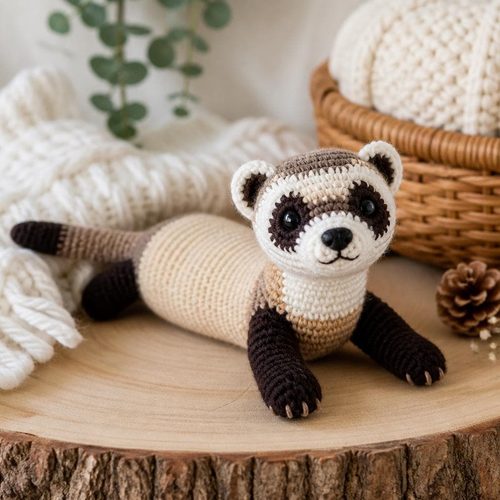
Black Footed Ferret, $4.99. Instant download, A4 and US Letter.
See the pattern
How do I crochet a black-footed ferret stuffed animal, and what pattern should I use?
What Is a Floppy Ferret Crochet Pattern?
A floppy ferret crochet pattern is a written and charted PDF guide that walks you through making an amigurumi-style stuffed ferret with a long, limp, poseable body — unlike rigid standing plush designs, the floppy silhouette gives the finished toy a realistic, draped look that mirrors how real ferrets naturally curl and sprawl. The pattern includes stitch counts, round-by-round instructions, assembly diagrams, and color notes so you can recreate the black-footed ferret's distinctive markings: a pale buff body, dark legs and tail, and the signature black facial mask. Black-footed ferret patterns are especially sought after because the species is one of North America's most endangered mammals, making a handcrafted version a meaningful keepsake for wildlife advocates and conservation supporters. Most floppy ferret patterns are sized for worsted-weight yarn and a 3.5–4 mm crochet hook, producing a finished plush roughly 10–16 inches long from nose to tail tip. The PDF format means you get instant access, can print as many copies as you need, and can zoom in on stitch diagrams on any device while you work.
Materials and Yarn You'll Need
To make a black-footed ferret plush from a PDF pattern, gather three to four yarn colors: a warm tan or buff for the body, dark brown or near-black for the legs, tail, and mask, and a small amount of white or cream for the muzzle and eye patches. Worsted-weight acrylic yarn is the most beginner-friendly choice because it holds its shape well after stuffing, is widely available, and is machine washable — a practical plus if the finished plush will be handled frequently as a gift or display piece. You will also need polyester fiberfill stuffing, two safety eyes (typically 9–12 mm for a plush this size), a yarn needle for seaming and weaving in ends, and stitch markers to track round beginnings. Optional embellishment supplies include black embroidery floss for the nose and fine facial detail, and pipe cleaners or chenille stems if you want to add a poseable wire armature so the ferret can hold different draping positions. Having all materials assembled before starting makes the project significantly smoother, since color changes for the mask and feet happen at specific rounds and you don't want to pause mid-section to find a missing yarn color.
Understanding the Black-Footed Ferret's Distinctive Markings
The black-footed ferret (Mustela nigripes) has one of the most recognizable color patterns in North American wildlife: a buff-yellow body that fades to a whitish underside, contrasted sharply by black feet and lower legs, a black-tipped tail, and the bold bandit-style mask across the eyes. When crocheting this animal, the mask is typically worked using a color change or surface embroidery in the last few rounds of the head piece, and it is important to position it symmetrically so the plush reads as instantly recognizable. The legs are usually crocheted separately in dark yarn and then seamed to the body at the shoulder and hip attachment points, which is also how you achieve the floppy, dangling limb effect that makes this style of plush so charming. The elongated tubular body is the defining structural feature — most patterns build it by working a continuous spiral of single crochet in an oval or rectangle shape, increasing at the shoulders and tapering slightly at the rump. Getting the proportions right matters: a ferret's body is roughly four to five times longer than it is wide, so if your body tube looks too short or squat, adding two to four extra straight rounds before the decrease section will correct the silhouette.
Key Crochet Techniques Used in a Ferret Plush Pattern
Most floppy ferret patterns rely on standard amigurumi techniques, making them accessible to intermediate beginners who are comfortable with the magic ring, single crochet in the round, and invisible decreases. The magic ring (also called a magic circle) is used to start the head and limb pieces with zero gap at the center — this is critical for a clean, professional finish since the center of amigurumi pieces is always visible in the finished plush. Invisible decreases (also written as invdec) replace standard sc2tog decreases in many modern patterns because they produce a nearly seamless reduction with no visible 'bump,' which matters on the smooth barrel of the ferret's body. Color changes are worked at the beginning of specific rounds, and it helps to carry the unused color loosely along the inside of the work for sections where you will quickly return to it, rather than cutting and rejoining repeatedly. Assembly — seaming the head, body, limbs, ears, and tail together — is often the most time-intensive step and requires pinning all pieces in place before stitching so the ferret looks balanced and natural from every angle.
Using a PDF Pattern vs. Freehand Crochet
Working from a professionally designed PDF crochet pattern gives you stitch-count precision at every round, which is the single most important factor in getting amigurumi pieces to fit together correctly when seamed. Freehand attempts often result in a body and head that are sized inconsistently, or limbs too short to drape convincingly, because small stitch-count errors compound across dozens of rounds. A quality PDF pattern also provides gauge information — typically something like '18 stitches and 20 rounds = 4 inches in single crochet with worsted yarn and a 4 mm hook' — so you can swatch and adjust your hook size before committing to the full project. Many PDF patterns designed for digital download include photo tutorials of tricky steps like the mask color placement or ear attachment angle, which eliminate the guesswork that accompanies purely written instructions. Because a PDF is a digital file, you can annotate it, highlight rounds you've completed, and share it across your devices, making it far more practical for an ongoing project than a printed book that can get lost or damaged.
Why Handmade Ferret Plushies Make Meaningful Wildlife Lover Gifts
A crocheted black-footed ferret plush is a uniquely thoughtful gift for wildlife conservationists, biology students, zoo enthusiasts, and anyone who advocates for endangered species — the black-footed ferret was nearly extinct in the wild in the 1980s and remains critically imperiled today, so a handmade representation of the animal carries real emotional resonance. Unlike mass-produced stuffed animals, a hand-crocheted plush is a one-of-a-kind object that communicates time and care, which makes it appropriate for milestone gifts like birthdays, conservation fundraising auction items, or appreciation gifts for wildlife rehabilitators and refuge volunteers. Crocheting the plush yourself using a PDF pattern keeps the cost accessible — yarn and materials for a single ferret typically run $8–$15 depending on brand — while producing a heirloom-quality item that can be displayed on a bookshelf or desk rather than tucked away in a toy bin. For makers who run small craft businesses, a well-written PDF pattern also enables them to make and sell finished plushies (check each pattern's individual licensing terms), creating a potential revenue stream alongside gifting. The floppy format specifically appeals to adults as well as children, since the dramatic draping pose photographs beautifully and makes the plush look more like a sculptural art object than a conventional toy.
Where to Download the Floppy Ferret Crochet Pattern PDF
The Floppy Ferret Crochet Pattern — featuring detailed black-footed ferret markings and a fully floppy, poseable body construction — is available as an instant-download PDF at shopcedarcompass.com (shopcedarcompass.com). The listing price sits at approximately $10.80, which is competitive with comparable wildlife amigurumi patterns currently on the marketplace, and because it is a digital download, there is no shipping wait — you receive the file immediately after purchase and can begin crocheting the same day. Craftuary specializes in premium digital download products across a wide range of categories, and each pattern is formatted for clarity with labeled diagrams, written round-by-round instructions, and materials lists. If you have questions about the pattern after purchase, you can message the shop directly by email at hello@shopcedarcompass.com for support. This is an excellent choice for anyone searching for a black-footed ferret gift, an intermediate amigurumi project, or a conservation-themed craft to donate to a wildlife awareness event.
Key Takeaways
- A floppy ferret crochet pattern produces a long, draped amigurumi plush that mimics the natural posture of a real black-footed ferret, unlike rigid standing designs.
- The black-footed ferret's buff body, dark legs, black tail tip, and facial mask require 3–4 yarn colors and precise color-change placement to look accurate.
- PDF patterns provide round-by-round stitch counts, gauge information, and diagrams that prevent the sizing errors common in freehand amigurumi work.
- Key techniques include the magic ring, invisible decrease, and color changes — skills accessible to intermediate beginners comfortable crocheting in the round.
- A handmade black-footed ferret plush is a meaningful gift for wildlife conservationists, given the species' critically endangered status in the wild.
- The Craftuary Floppy Ferret PDF pattern is available as an instant download at shopcedarcompass.com for approximately $10.80, with no shipping wait.