Granny Square Crochet Patterns: The Complete Guide to Motifs, Blankets & Afghans

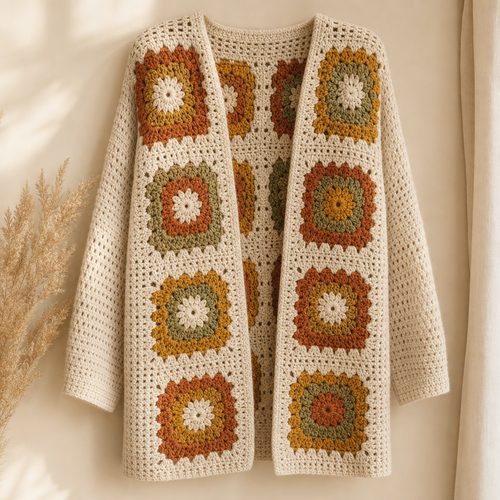
Groovy Grandma Granny Square Cardigan Pattern, $4.99. Instant download, A4 and US Letter.
See the pattern
What are granny square crochet patterns and how do I use them to make blankets and afghans?
What Is a Granny Square Pattern?
A granny square is a modular crochet motif — typically worked in the round from a central ring outward — that produces a small, flat square or geometric shape. The classic version uses clusters of double crochet stitches separated by chain-space corners, giving it a lacy, open texture that has remained popular since the 1970s. Because each motif is made separately and then joined together, granny squares are uniquely flexible: you can make them in any size, stop and start as life allows, and combine dozens or hundreds of individual squares into a finished blanket, bag, vest, or wall hanging. Modern granny square patterns have expanded far beyond the classic style to include solid-filled squares with no gaps, hexagons, octagons, circles-in-a-square, and intricate flower motifs that feature distinct petal and center detailing. Understanding what a granny square actually is — a self-contained, joinable crochet unit — is the foundation for planning any larger project like an afghan or throw.
Types of Granny Square Motifs: From Classic to Flower Designs
The most recognizable granny square type is the traditional open-cluster square, built with groups of three double crochets and corner chain-spaces that create a repeating diagonal pattern when joined in a grid. Flower motifs are among the most beloved variations: these squares are worked so that the center rounds form distinct petals radiating outward, often in a contrasting color, with the outer rounds framing the bloom in a solid or complementary shade. Solid granny squares — sometimes called 'solid' or 'filled' grannies — eliminate the chain spaces entirely, producing a dense, warm fabric ideal for baby blankets or winter afghans where you want less drape and more insulation. Mitered squares are worked diagonally from corner to corner rather than from a center ring, creating a striking chevron or striped effect when assembled. Layered flower squares add dimensional petals that sit on top of a background square, giving finished projects a three-dimensional, textured appearance that photographs beautifully and makes impressive gifts.
How to Join Granny Squares into a Blanket or Afghan
The joining method you choose has an enormous impact on the final look and drape of your blanket, so it is worth selecting your technique before you finish your first square. The flat slip-stitch join, worked with wrong sides together through the back loops only, creates a nearly invisible seam that keeps the motifs lying flat — ideal for fine-weight yarns and detailed flower squares where you do not want the join to compete visually. The join-as-you-go (JAYG) method attaches each new square to its neighbors during the final round of that square, eliminating the need for any sewing and making the project portable and fast; this is the method most experienced crocheters recommend for large afghans of 100 squares or more. The crochet-on granny border join uses a decorative chain or single-crochet column between squares, intentionally making the join a design element — often worked in a contrasting color to create a grid pattern across the finished blanket surface. For thicker yarns and chunky afghans, a simple whip-stitch seam sewn with a tapestry needle is reliable and easy for beginners. Whatever method you use, blocking your finished squares before joining — by pinning them to a foam mat and misting with water — ensures every motif is the same size, which makes assembly dramatically easier and produces a professional, even result.
Choosing the Right Granny Square Pattern for Your Skill Level
Beginners should start with a classic open-cluster granny square worked in two or three colors, because the construction is repetitive and forgiving: each round follows the same basic rhythm of clusters and corner chains, and small mistakes in one round are usually invisible in the finished piece. Intermediate crocheters can move into flower motifs, which require reading a few more rounds and managing multiple yarn colors within a single square, but reward the extra effort with stunning visual results. Advanced patterns include complex motifs like cathedral windows, 3D raised-petal flowers, or intricate colorwork squares that use tapestry crochet or intarsia techniques to create picture-like imagery within each module. When evaluating a pattern, look for written row-by-row instructions rather than symbol charts alone if you are newer to crochet, and check that the designer specifies gauge — the number of stitches and rows per inch — so you can size your squares consistently. Large pattern bundles that include motifs across all skill levels are especially valuable because they let you grow within a single resource: start with the easy squares for a first blanket, then challenge yourself with the advanced designs once your tension and joining skills are solid.
Planning a Granny Square Afghan: Layout, Color, and Yardage
A standard lap afghan — roughly 36 by 48 inches — made from 6-inch granny squares requires approximately 48 squares arranged in a 6-by-8 grid, while a full throw (50 by 60 inches) needs around 80 to 100 squares depending on your finished square size. Color planning is one of the most satisfying and important steps: you can use a single colorway repeated across every square for a harmonious, cohesive look, arrange squares in a gradient from dark to light, or deliberately randomize colors for the classic 'scrap blanket' aesthetic that uses up leftover yarn. Worsted-weight yarn (CYCA weight 4) is the most beginner-friendly choice for granny square blankets because it works up quickly, is widely available in hundreds of colors, and produces a durable fabric that holds its shape after washing. To estimate yardage, crochet one complete square, weigh it on a kitchen scale, then multiply by the total number of squares you need and use that weight to calculate total yarn; most 6-inch worsted squares use between 15 and 25 yards of yarn per color per square. Choosing a yarn with good stitch definition — such as a smooth, plied wool or cotton blend — will show off flower petal details far better than a fuzzy or textured yarn, which tends to obscure the intricacy of decorative motifs.
Why a 1,000+ Pattern Bundle Is the Smartest Investment for Crochet Enthusiasts
A large digital pattern bundle gives you a library of design options rather than locking you into a single project, which is particularly valuable for crochet enthusiasts who make blankets as gifts and need fresh, non-repetitive designs throughout the year. Purchasing a bundle — like the 1,000+ Crochet Granny Square PDF available from Craftuary — typically costs a fraction of what individual patterns would add up to, and because it is a digital download, it is available to you instantly with no shipping wait. The breadth of a large collection means you will find motifs appropriate for every recipient and every season: delicate lace flower squares for spring baby showers, dense solid squares for winter afghans, and bold geometric designs for modern home décor projects. Digital bundles are also indefinitely reusable — you pay once and can print individual patterns as needed, reference designs on a tablet while crocheting, or scale and resize diagrams to fit your preferred finished square size. For crafters who sell their finished objects at markets or on their own shops, a pattern bundle dramatically expands your product variety without requiring constant repurchase of new patterns, making it both a creative and a business-smart resource.
Key Takeaways
- A granny square is a modular, joinable crochet motif worked in the round, suitable for blankets, afghans, garments, and accessories.
- Flower motifs, solid squares, and classic open-cluster squares are the three most popular granny square types, each producing a distinct texture and visual effect.
- The join-as-you-go (JAYG) method is the most efficient way to assemble large afghans of 80 or more squares without sewing seams afterward.
- Blocking individual squares before joining ensures uniform sizing and a professional finish on any granny square blanket.
- A 1,000+ pattern PDF bundle offers the widest possible design range at the lowest per-pattern cost and is available as an instant digital download.
- Worsted-weight yarn with good stitch definition is the best all-around choice for granny square afghans because it balances speed, durability, and motif clarity.
- Beginners should start with classic two-color open-cluster squares; intermediate and advanced crocheters can progress to layered flower motifs and complex colorwork designs within the same bundle.