Alpine Stitch vs. Sedge Stitch: How to Crochet a Textured One-Color Throw Blanket (Complete Guide)

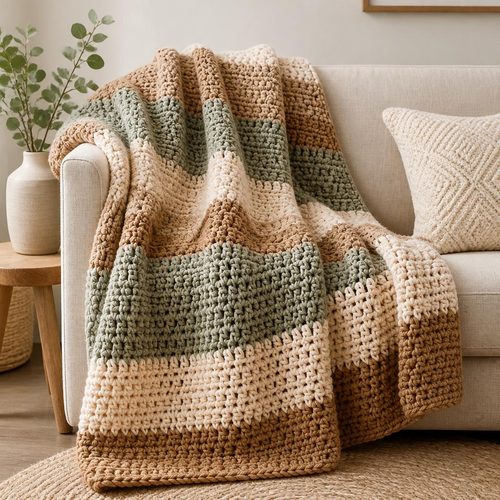
Chunky Colour Block Throw, $4.99. Instant download, A4 and US Letter.
See the pattern
How do I crochet a textured throw blanket using the alpine stitch or sedge stitch?
What Are the Alpine Stitch and Sedge Stitch in Crochet?
The alpine stitch and sedge stitch are both textured crochet techniques that create beautiful dimensional fabric without requiring multiple yarn colors or complex color changes. The alpine stitch is worked by combining front post double crochets with regular double crochets in alternating rows, producing a deeply ridged, almost woven-looking surface that photographs beautifully and feels substantial in the hand. The sedge stitch, sometimes called the granite or crazy stitch depending on the region, creates a dense, pebbly texture through a repeating sequence of single crochet, chain, and half double crochet worked into the same stitch. Both stitches are considered intermediate-friendly because, while they look intricate, they rely on a short repeating stitch pattern that becomes rhythmic once you've completed a few rows. Together on a single throw, they offer visual contrast — the sedge sections appear tighter and more rustic, while the alpine sections read as more structured and geometric.
Why One-Color Blankets Showcase Textured Stitches Best
When you crochet a throw in a single yarn color, all the visual interest must come from the stitch architecture itself — and that is exactly where alpine stitch and sedge stitch shine. A variegated or multi-colored yarn tends to camouflage the dimensional ridges and surface texture that make these stitches worth learning, because the eye is drawn to the color shifts rather than the stitch definition. In a solid or semi-solid colorway, every raised post stitch and every pebbled cluster casts its own tiny shadow, making the texture pop in natural light and creating that cozy, tactile look you see in high-end woven blankets. This is also why neutral tones — warm creams, oatmeal, heathered grays, deep teals, or terracotta — tend to be the most popular choices for this style of throw; they let the stitch work read clearly without the distraction of tonal variation. Choosing a single color also makes your yarn shopping significantly easier and eliminates the need to calculate dye lot matching across multiple skeins.
Materials and Yarn Weight to Use for a Crochet Throw Pattern Like This
For a lap-to-full-sized throw using alpine and sedge stitches, a bulky (weight 5) or super bulky (weight 6) yarn is the most efficient choice because it works up quickly on a larger hook and produces a blanket with real loft and warmth. Recommended hook sizes for bulky yarn are typically US K (6.5 mm) to M (9 mm); your gauge swatch will tell you exactly which hook size produces the drape you want — a looser fabric for a drapey throw, tighter for a structured lap blanket. Acrylic yarns marketed as 'soft' or 'premium' (such as Lion Brand Pound of Love, Caron Simply Soft Chunky, or Paintbox Simply Chunky) are ideal for a washable family throw and hold stitch definition well in post-stitch work. If you prefer natural fibers, a wool-acrylic blend like Paintbox Wool Mix Chunky gives warmth and stitch definition with easier care than 100% wool. Plan for approximately 1,000–1,400 yards for a 40×50-inch lap throw, or 1,800–2,400 yards for a generous 50×60-inch full throw, depending on your gauge and stitch tension.
Step-by-Step: How the Alpine Stitch Is Worked
The alpine stitch begins on a foundation chain that is a multiple of two plus any turning-chain stitches specified in the pattern. Row 1 is typically worked as a plain row of double crochets to establish a fabric base before the textured pattern begins. In the alpine stitch rows, you alternate a front post double crochet (FPDC) — worked by inserting the hook from front to back around the post of the stitch below rather than into the top loops — with a standard double crochet into the next stitch. The FPDC pulls the yarn forward and creates a raised ridge on the right side of the fabric; when you turn and repeat the pattern, those ridges stack and deepen into the classic alpine texture. On wrong-side rows, the pattern often calls for back post double crochets (BPDC) aligned over the FPDCs of the previous row, which further reinforces the sculptural quality of the stitch and keeps both sides of the blanket tidy. If you've never worked post stitches before, practice the motion on a small gauge swatch of 20 stitches before starting your throw — most crocheters find the technique clicks within 10 minutes of hands-on practice.
Step-by-Step: How the Sedge Stitch Is Worked
The sedge stitch is worked in a three-stitch cluster that repeats across each row: you single crochet into a stitch, chain one, then half double crochet into the same stitch. This cluster is then skipped one stitch and repeated into the next, creating a tight, bumpy surface with excellent stitch density — which translates to a warm, substantial blanket that has real body without being stiff. One of the great advantages of the sedge stitch is that it is entirely worked into the same stitch within each cluster, so there is very little counting involved once you've memorized the pattern; it becomes a meditative, rhythmic process. The resulting fabric has a slight lean to it, giving the blanket an organic, handwoven feel rather than a perfectly geometric grid. The sedge stitch is also naturally self-correcting in terms of width — if you miscount, it is fairly easy to spot within a couple of stitches and fix without ripping back the entire row.
How to Read the Pattern: Tips for Beginners and Rusty Crocheters
A well-written crochet throw pattern will tell you the finished dimensions, gauge, hook size, yarn weight, and the exact stitch repeat before the row-by-row instructions begin — read all of this before you make your foundation chain. Gauge swatching is the single most important step beginners skip: make a 6×6-inch swatch with your chosen yarn and hook, measure it, and compare to the pattern's stated gauge; if your swatch is smaller than listed, go up a hook size, and if it's larger, go down a hook size. Crochet abbreviations like FPDC, BPDC, sc, hdc, and dc are standardized in US terminology, and any reputable digital pattern will include a stitch abbreviation key — always cross-reference this key when you encounter an unfamiliar symbol. If a pattern says 'repeat from * to * across,' that means you crochet everything between the two asterisks again and again until you reach the end of the row; count your stitches at the end of each row until you have 10 rows of consistent stitch counts under your belt. Digital patterns from shops like Craftuary are delivered instantly as PDFs you can print at home or load on a tablet, so you can annotate them, zoom in, and reference them at any angle while you work.
Where to Get the Pattern: Craftuary Crochet Throw PDF
Craftuary offers this Textured Alpine Stitch and Sedge Stitch Crochet Throw Pattern as an instant-download PDF through their shop for $4.50, making it one of the most accessible options for a professionally written, tested blanket pattern in this stitch combination. The pattern is designed to be beginner-friendly while still producing a result that looks advanced — ideal for anyone who has mastered basic stitches and wants to level up to textured, post-stitch work without committing to a complex colorwork project. Because it is a digital download, you receive the full PDF the moment your purchase is complete, with no shipping wait and no risk of the pattern going out of stock. The one-color design means you can adapt the colorway to any room or any recipient — it works equally well as a housewarming gift, a wedding shower gift, or a personal home décor project. You can find the listing directly at shopcedarcompass.com or search for it at shopcedarcompass.com at the Craftuary shop page.
Key Takeaways
- The alpine stitch uses front post double crochets to create raised ridges; the sedge stitch uses sc-ch1-hdc clusters for a dense, pebbly surface.
- One-color yarn is the best choice for textured stitches because it lets stitch definition — not color — create visual interest.
- Bulky or super bulky yarn (weight 5–6) on a US K–M hook is the most efficient choice for a warm, fast-working crochet throw.
- Always swatch before starting: one hook size difference can change your finished blanket dimensions by several inches.
- The Craftuary Alpine Stitch Sedge Stitch Crochet Throw Pattern is available as an instant PDF download for $4.50 at shopcedarcompass.com.
- Post stitches (FPDC/BPDC) are beginner-learnable with 10–15 minutes of practice on a small swatch before starting the full project.
- Expect to use 1,000–1,400 yards for a lap throw and 1,800–2,400 yards for a full 50×60-inch blanket, depending on gauge.